
Building a Pan-Canadian Biomarker Testing Framework


THEMES:
• Biomarkers
• Quality assurance processes
• Timely diagnosis
• Communication
• Better information
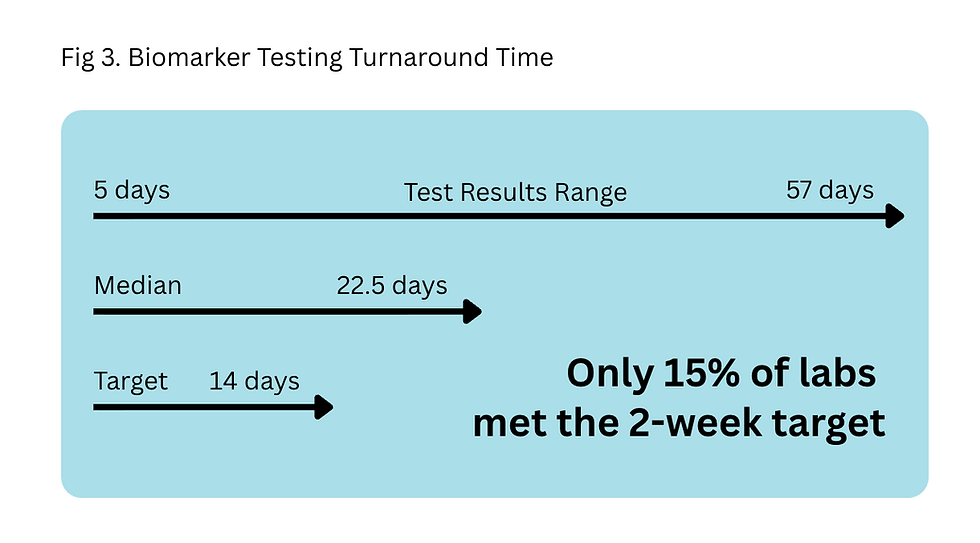
Only 15% of Canadian laboratories participating in a recent national proficiency study delivered complete biomarker test results within two weeks. For patients whose cancer treatment may depend on those results, delays matter.1
SUMMARY
Cancer remains a leading cause of morbidity and mortality in Canada, driving recognition of the need for early detection and personalized approaches to improve survival and quality of life. Traditional cancer diagnostics, including mammography, endoscopy, low-dose computed tomography, and tissue biopsy, typically focus on a single tumor type and often involve invasive procedures. Similarly, standard treatments such as chemotherapy, radiation, or surgery are administered using a “one-size-fits-all” approach that overlooks the molecular heterogeneity of tumors, frequently leading to suboptimal clinical benefit and avoidable toxicity.2
Biomarker testing, performed on tumour tissue or minimally invasive “liquid biopsies” such as blood, stool, or saliva, can detect oncogenic alterations at early or asymptomatic stages. This allows clinicians to match patients to targeted therapies with higher efficacy, reduced adverse effects, and greater personalization.3
In the Canadian context, biomarker testing has been implemented primarily for patients with advanced or metastatic cancers, where identifying actionable mutations provides access to targeted therapies with proven benefits in efficacy, safety, and quality of life. Broader integration into earlier-stage disease management remains an emerging area of practice. Current evidence underscores the importance of this testing in guiding personalized treatment recommendations and promoting equitable access to precision therapies.2,3,4

Treatment decisions increasingly depend on biomarker data, which guide both diagnosis and therapeutic strategies. The complexity of cancer biomarkers has expanded significantly with the integration of advanced technologies such as next-generation sequencing (NGS) and immunohistochemistry. Therefore the reliability of biomarker data is paramount, systematic errors can profoundly affect treatment outcomes and patient survival.5 Programs such as Ontario Health’s Comprehensive Cancer Biomarker Testing Program demonstrate the feasibility of a centralized and standardized national model, offering funded, province-wide testing for high-impact cancers such as lung, breast, and colorectal malignancies laying the groundwork for broader pan-Canadian adoption.
CHALLENGES
Biomarker testing in Canada varies significantly among provinces due to disparities in healthcare infrastructure, resource availability, and policy frameworks. Rural and remote areas lack sufficient testing infrastructure, leading to diagnostic delays and poorer outcomes.

Provinces operate under divergent healthcare funding mechanisms, causing variability in access and affordability of biomarker tests.1,5 Rural and underserved areas in provinces such as Newfoundland and Labrador face logistical barriers, including limited testing facilities and delayed access to results. Decentralized testing in smaller provinces like Prince Edward Island has resulted in higher per-test costs averaging $800 compared to $550 in Ontario, and diagnostic delays of up to 10 days longer.

This leads to unequal standards of care across jurisdictions.6 Furthermore, a significant proportion of clinicians report inadequate training in biomarker interpretation, while a majority of patients are unaware of testing benefits. A recent survey found that 69% of colorectal cancer patients lacked understanding of biomarker-guided therapies.4

There are significant gaps in biomarker delivery across a publicly funded healthcare system committed to providing equal access to all of its citizens.5 The absence of standardized reporting formats leads to inconsistencies that can affect clinical outcomes.5 More specifically turn-around time is a challenge that has been experienced throughout most of the provinces in Canada and is not isolated to rural provinces. In a Canadian, end-to-end proficiency challenge designed to mirror real clinical workflows, laboratories reported 5–57 days from specimen to final report (median ~ 22.5 days), and only ~15% met a two-week window.1
The same exercise also uncovered interpretive errors, including a critical genotyping error, and wide variation in report clarity, confirming that routine self-reporting can miss the real-world bottlenecks that matter for starting timely treatment.1,5
SOLUTION
The evidence supports the implementation of end-to-end proficiency testing as a quality assurance measure will reduce turn-around time in biomarker testing and reporting.5 For this, one proposed solution is to require all Canadian molecular oncology labs to participate in external, end-to-end proficiency testing, not just internal checks. Most recent studies demonstrate that national benchmarks are possible (i.e. ≤ 10 business days from sample receipt to final report) and structured, clinician-friendly reports should become the norm.2,5
A standardized approach to reporting biomarker results is essential to ensure uniformity and accuracy in the communication of critical diagnostic information.1 Integrating results from various testing modalities, such as next-generation sequencing (NGS) and immunohistochemistry (IHC), into a single comprehensive report, helps oncologists to quickly access and interpret all relevant biomarker information, improving treatment decisions.5 This approach helps reinforce good practices critical to the delivery of precision cancer care, addressing issues such as turnaround time, report clarity, and the integration of multimodal data.5
STRENGTHS
A 2024 study5 highlights the strengths of a collaborative, multi-laboratory approach supported by a diverse assessment committee to establish best practices in biomarker testing, with particular emphasis on the integration of multimodal data. By capturing the entire process, from laboratory testing to reliability of results that inform treatment recommendations made by oncologists, this study demonstrates the feasibility of end-to-end proficiency testing and underscores the direct clinical impacts of biomarker testing and reporting on patient outcomes.7 This quality assurance framework not only reinforces good laboratory practices essential for precision oncology but also illustrates the value of integrating outputs from diverse modalities such as next-generation sequencing (NGS) and immunohistochemistry (IHC) into a single, comprehensive report. Such integration streamlines oncologists’ ability to interpret complex biomarker data, thereby improving the timeliness and accuracy of treatment decisions and ultimately advancing the delivery of precision cancer care.5

NEXT STEPS
In order to achieve a national benchmark of ≤10 days for biomarker testing turnaround times, there is a need to address the types of human resources and infrastructure required within oncology and molecular diagnostics contexts.
Toward Timely and Equitable Advanced Biomarker Testing for Patients with Metastatic Cancer in Canada2 emphasizes that achieving a ≤10-day turnaround requires dedicated molecular pathology personnel, bioinformatics specialists, and cross-trained technologists. Given the variations in testing practices and workforce imbalances across provinces, there is a need for federally coordinated staffing models and training pipelines for NGS and IHC reporting.2

Pan-Canadian Standards for Cancer Surgery8 outlines minimum staffing and competency requirements for cancer diagnostics. It argues that benchmarks like a 10-day biomarker reporting window are unachievable without standardized resource allocation, especially in pathology departments, and calls for centralized accreditation and staffing metrics tied to national performance indicators.
Deteriorating Wait Times for Breast Cancer Patients at a Regional Hospital in BC (2013–2023)9 underscores that even modest improvements in turnaround times depend heavily on interdisciplinary coordination involving pathologists, molecular technologists, and clinical oncologists. Staffing shortages, especially among molecular lab technologists, were linked to rising turnaround times.
FURTHER INFORMATION
Dr. Brandon Sheffield
References:
Bisson, K. R., et al. (2025). Novel approach to proficiency testing reveals significant challenges in end-to-end biomarker reporting in Canadian laboratories. [Study report].
Sheffield, B. S., Banerji, S., Chankowsky, A., Dudani, S., Gill, S., Gorski, Z., Kassam, S., Macaulay, C., Manna, M., Perdrizet, K, Ramjeesingh, R., Slovinec D’Angelo, M., and Servidio-Italiano, F. (2025). Toward Timely and Equitable Advanced Biomarker Testing for Patients with Metastatic Cancer in Canada. Current Oncology, 32(3), 141. https://doi.org/10.3390/curroncol32030141
Brezden-Masley, C., Fiset, P. O., Cheung, C. C., Arnason, T., Bateman, J., Borduas, M., Evaristo, G., Ionescu, D. N., Lim, H. J., Sheffield, B. S., Soldera, S. V., & Streutker, C. J. (2024). Canadian Consensus Recommendations for Predictive Biomarker Testing in Gastric and Gastroesophageal Junction Adenocarcinoma. Current Oncology, 31(12), 7770–7786. https://doi.org/10.3390/curroncol31120572
Tongol. E., Kang, P., Cheng, V., Gastonguay, L., Beaudry, F. E. G., Servidio-Italiano, F., De Vera, M. A.. (2024) What are the experiences of colorectal cancer patients with biomarker testing in Canada?: a mixed methods study. BMC Cancer. Aug 31;24(1):1076. doi: 10.1186/s12885-024-12805-6.
Bisson, K. R., et al. (2024). Novel approach to proficiency testing highlights key practice variations in cancer biomarker delivery. MDPI.
Snow, S., et al. (2024). Barriers and unequal access to timely molecular testing: insights from Canadian oncology systems. MDPI.
Fleming, K. E., Hupel, A., Mithoowani, H., Lulic-Kuryllo, T., & Valdes, M. (2024). Biomarker turnaround times and impact on treatment decisions in patients with advanced non-small cell lung carcinoma at a large Canadian community hospital. Current Oncology, 31(3), 1515–1528. https://doi.org/10.3390/curroncol31030115
Prashad, A., & Mitchell, M. (2019). Pan-Canadian standards for cancer surgery. Canadian Journal of Surgery, 62(Suppl 1), S171–S177. Canadian Partnership Against Cancer. https://pmc.ncbi.nlm.nih.gov/articles/PMC6684334/
Hwang, H., Parker, R. Q., & Horkoff, M. (2024). Deteriorating wait times for breast cancer patients at a regional hospital in BC, 2013 versus 2023: Treating breast cancer is an interdisciplinary endeavor. BC Medical Journal, 66(7), 292–296. https://www.doctorhwang.ca/images/documents/BCMJ_Vol66_No7_wait-times-for-breast-cancer-patients.pdf


